
Dalam paradigma Object-Oriented Programming (OOP), class merupakan sebuah blueprint yang dapat dikembangkan untuk membuat sebuah objek.
Blueprint ini merupakan sebuah template yang di dalamnya menjelaskan seperti apa perilaku dari objek itu (berupa properti ataupun method).
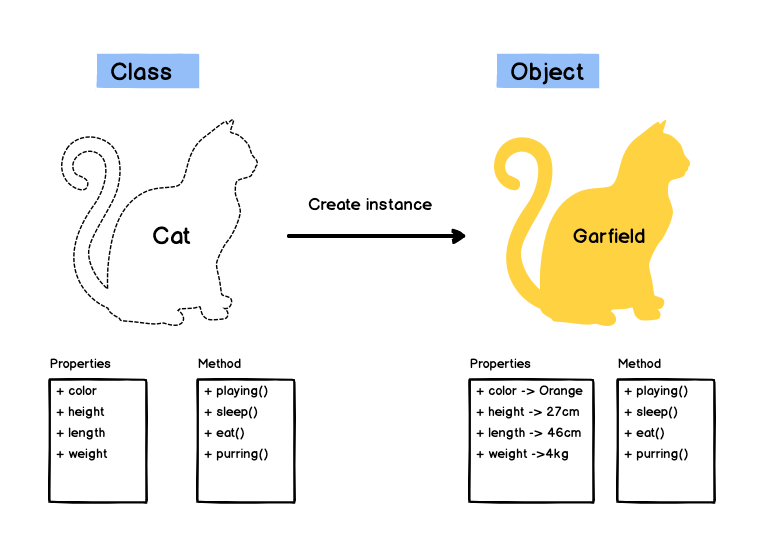
Paradigma OOP selalu digambarkan dengan kehidupan nyata. Visualisasi di atas mencontohkan gambaran umum OOP di mana terdapat sebuah blueprint kucing, nilai yang dimiliki kucing, dan kemampuan yang dapat dilakukan olehnya.
Dalam OOP blueprint tersebut dikenal dengan class (kelas), nilai yang dimiliki olehnya dikenal dengan properti, kemampuan yang dimilikinya dikenal sebagai behaviour/method dan realisasi dari sebuah blueprint tersebut disebut instance.
Dalam dunia pemrograman khususnya dalam paradigma OOP, kita sering membuat banyak objek dengan jenis yang sama. Dengan membuat blueprint ini kita dapat mengurangi duplikasi kode dalam membuat objek yang serupa
Kebanyakan bahasa pemrograman memanfaatkan class dalam penerapan paradigma OOP. Pada JavaScript tidak ada konsep class murni bahkan hingga saat ini. Namun bukan berarti kita tidak bisa menerapkan paradigma OOP sepenuhnya.
Seperti yang kita ketahui, class pada OOP merupakan sebuah blueprint. Jika berbicara mengenai blueprint, JavaScript memiliki konsep untuk membuatnya tanpa melalui class. Konsep tersebut adalah prototype. Sejak awal developer menggunakan konsep ini dalam menerapkan paradigma OOP di JavaScript.
Walaupun dapat menggantikan class, konsep prototype tidak serupa dengan class pada bahasa lain. Terlebih pada penulisan sintaknya. Hal ini menjadikan banyak developer kebingungan khususnya developer yang dasarnya dari bahasa class basis (seperti Java, C++, C#, Swift, etc.). Meskipun banyak juga developer yang merasa bahwa class tidak diperlukan pada JavaScript, namun fitur class ini tetap menjadi salah satu yang dikembangkan pada ECMAScript 6.
A Class Before ES6
Sebelum ES6, Hal yang paling mendekati dengan class yaitu membuat sebuah objek menggunakan constructor function dan keyword new, lalu untuk menambahkan method kita gunakan konsep prototype.
- function Car(manufacture, color) {
- this.manufacture = manufacture;
- this.color = color;
- this.enginesActive = false;
- }
- Car.prototype.startEngines = function () {
- console.log('Mobil dinyalakan...');
- this.enginesActive = true;
- };
- Car.prototype.info = function () {
- console.log("Manufacture: " + this.manufacture);
- console.log("Color: " + this.color);
- console.log("Engines: " + (this.enginesActive ? "Active" : "Inactive"));
- }
- var johnCar = new Car("Honda", "Red");
- johnCar.startEngines();
- johnCar.info();
- /* output:
- Mobil dinyalakan...
- Manufacture: Honda
- Color: Red
- Engines: Active
- */
Pada kode di atas Car merupakan constructor function yang akan membuat instance Car baru setiapkan kode new Car() dieksekusi. Melalui Car.prototype, method startEngines() dan carInfo() diwarisi pada setiap instance Car yang dibuat, sehingga johnCar (sebagai instance Car) dapat mengakses kedua method tersebut.
Teknik dasar ini yang digunakan dalam membuat class di JavaScript sebelum ES6.
“Mengapa method pada instance harus disimpan pada prototype atau __proto__ ? Mengapa tidak disimpan pada constructor sama seperti properti?Alasannya adalah jika kita menyimpan method pada constructor maka method tersebut akan selalu dibuat ketika instance dibuat. Ini bukan pendekatan yang baik karena jika method memiliki kode yang banyak, maka akan memakan memori yang banyak.Sedangkan jika menggunakan prototype, method hanya dibuat satu kali. Dan method tersebut diwarisi kepada setiap instance yang dibuat.”
ES6 Classes
Dengan hadirnya class pada ES6, pembuatan class di JavaScript menjadi lebih mudah dan juga penulisannya mirip seperti bahasa pemrograman lain berbasis class. Pembuatan class pada ES6 menggunakan keyword class itu sendiri kemudian diikuti dengan nama class-nya.
- class Car {
- // Sama seperti function constructor
- constructor(manufacture, color) {
- this.manufacture = manufacture;
- this.color = color;
- this.enginesActive = false;
- }
- // Sama seperti Car.prototype.startEngine
- startEngines() {
- console.log('Mobil dinyalakan...');
- this.enginesActive = true;
- }
- // Sama seperti car.prototype.info
- info() {
- console.log(`Manufacture: ${this.manufacture}`);
- console.log(`Color: ${this.color}`);
- console.log(`Engines: ${this.enginesActive ? "Active" : "Inactive"}`);
- }
- }
- const johnCar = new Car("Honda", "Red");
- johnCar.startEngines();
- johnCar.info();
- /* output:
- Mobil dinyalakan...
- Manufacture: Honda
- Color: Red
- Engines: Active
- */
Jika Anda terbiasa dengan bahasa pemrograman berbasis class, pasti penulisannya sangat serupa bukan?
Walaupun dari segi sintaksis pembuatan class antara keduanya cukup berbeda, namun perilaku dari objek yang dibuat dengan keduanya sama.
Inilah mengapa class pada ES6 hanya sebuah syntactic sugar dari konsep prototype yang sudah ada.
Walaupun dari segi sintaksis pembuatan class antara keduanya cukup berbeda, namun perilaku dari objek yang dibuat dengan keduanya sama.
Inilah mengapa class pada ES6 hanya sebuah syntactic sugar dari konsep prototype yang sudah ada.
“Ketika kita hendak membuat sebuah constructor function ataupun class. Secara code convention (aturan penulisan), gunakan CamelCase dalam penamaannya. Contohnya Car daripada car, SportCar daripada sportCar atau Sportcar

Bookmark